
During emergencies, people receive critical information in different ways. Some may see a Wireless Emergency Alert on their phone, while others may receive information through local radio, a social media post, a highway message board, or a community partner. Layered alerting brings communication methods together so critical information reaches more people and remains accessible as conditions change.
Alerting Authorities who coordinate the same message across multiple pathways can expand audience reach, reinforce protective actions, and provide backup options if a single communication pathway falls short.
Understanding Layered AlertingAt its core, layered alerting is the practice of using multiple communication pathways to support a common message. IPAWS dissemination pathways are often a key part of that approach, but they work best when paired with other tools such as agency websites, social media platforms, transportation messaging systems, and trusted community partners.

Repeating consistent instructions across several pathways improves the likelihood that communities not only receive an alert but understand what action they should take.
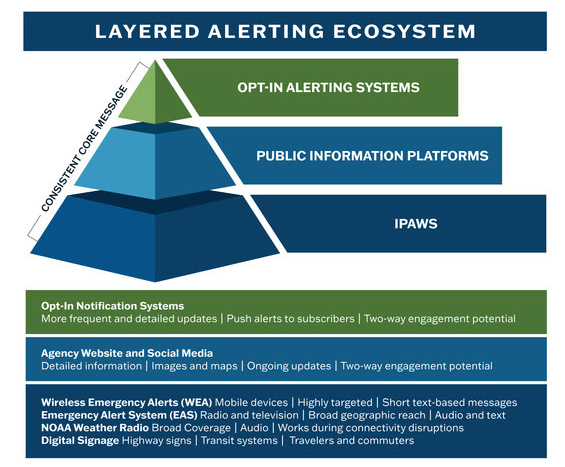
Each pathway has different strengths. Some reach broad audiences quickly, while others provide additional detail, visual information, or ongoing updates, and may require people taking action to find information.
Planning a Layered Alerting Strategy Before an IncidentLayered alerting is most effective when the groundwork is already in place before an emergency begins. Taking time to think through a few key considerations ahead of an incident can make communication decisions easier when conditions change quickly.
- Know your communication options. Take stock of the alerting and outreach pathways available in your jurisdiction. Understanding the strengths and limitations of each option makes it easier to select the right combination during an incident.
- Think about who needs the information. Residents are only one audience. Visitors, commuters, individuals with disabilities, and people with limited English proficiency may rely on different sources to receive emergency information. Considering those needs ahead of time can help shape a stronger communication strategy.
- Match pathways to urgency. Not every message requires the same level of interruption. For example, an immediate protective action may call for WEA and NOAA Weather Radio, while preparedness or awareness messaging may be better suited for web and social media channels.
- Clarify decision-making responsibilities. Identify who monitors hazards, selects communication pathways, drafts messages, approves alerts, and sends notifications. Planning for after-hours incidents, staff absences, and escalation procedures can help reduce delays when time matters most.
- Prepare messages and partner relationships in advance. Developing message templates before an incident can help streamline alert creation and support consistency across communications. Tools such as the Message Design Dashboard (MDD) can assist with template development, message validation, and previewing alert content before it is needed. Coordination with schools, transportation agencies, utilities, community organizations, and local media can also help reinforce key messages during an incident.
For example, during a wildfire, Alerting Authorities may use a geotargeted WEA to communicate immediate protective actions to people in the most at-risk areas. EAS and NOAA Weather Radio can reinforce those instructions and help broaden message reach as conditions change. Additional information, such as road closures, shelter locations, and recovery resources, can then be shared through agency websites and other information pathways. A few practices can help keep communications coordinated:
- Select communication pathways based on the situation. Consider the urgency of the incident, the audience being reached, and the action people need to take. Match pathway selection to urgency, audience, and desired outcome based on establish layered alerting strategy protocols. The Alerting Pathway Matrix1 can help identify appropriate dissemination pathways for different scenarios.
- Keep instructions consistent. Messages may vary in length or format across platforms, but the core protective action should remain the same. Inconsistent messaging across jurisdictional boundaries can create confusion and reduce public confidence.
- Coordinate with neighboring jurisdictions. Establishing procedures for information sharing, message coordination, and pathway selection before an incident can help maintain consistent protective action messaging across jurisdictions. Resources such as communication workflow diagram2 and documented standard operating procedures3 can help organizations identify communication pathways, define decision points, and clarify coordination roles and responsibilities before an event occurs.
- Start with concise, action-oriented alerts, then build on them. Initial alerts can communicate immediate protective actions, while supporting platforms can provide maps, shelter information, operational updates, and other details as conditions change.
Communities receive information in different ways, especially during emergencies. Layered alerting acknowledges that reality by bringing together multiple communication pathways around a shared message.
A small amount of preparation, such as reviewing available communication options, developing message templates, and coordinating with trusted partners, can make a meaningful difference when communities need timely information the most.
1. Pathway Matrix courtesy of Hawaii County Civil Defense Agency
2. Workflow Communication Diagram courtesy of City of Los Angeles Emergency Management
3. Standard Operating Procedure Document courtesy of Wake County Government, Fire Services/
Emergency Management Division